Lead the platoon. Carry the cost.
Shattered Doctrine is a human-scale war game about the price of war. It is realistic, it plays like a war film you're inside of, it refuses easy morality, and it is built to make you feel what command costs. Underneath that is a survival campaign, where you manage what little a stranded platoon has, and real-time tactical combat, where you spend it.
Situation
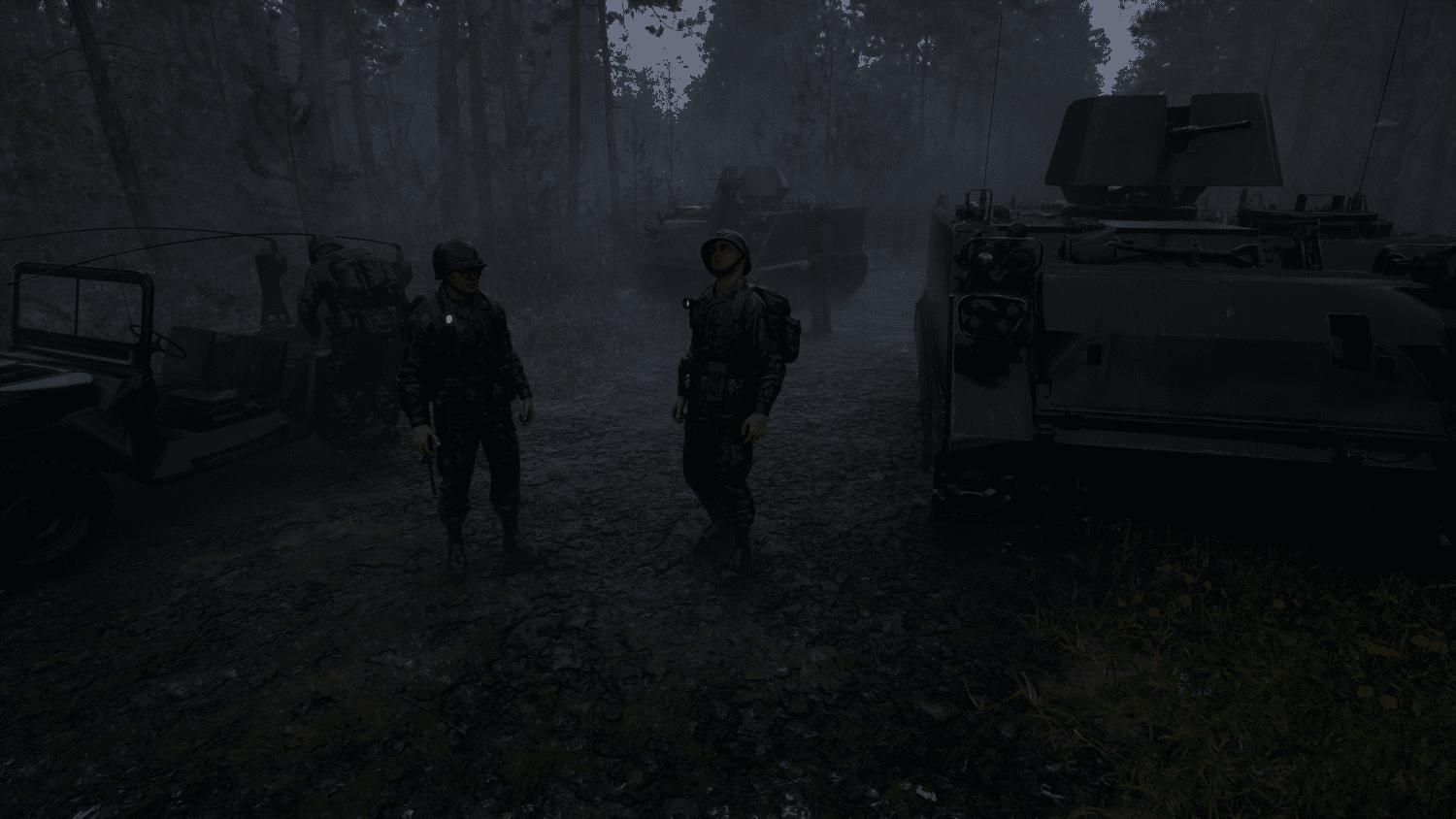
090340Z AUG 85 · The wrong side of the wirea. Enemy Forces. 03:40, 9 August 1985. The barrage lands on the positions 2nd Platoon was assigned, west of the border. Lost in fog on a misprinted overlay, the platoon is east of it — and the first echelon flows past on both sides.
b. Friendly Forces. By midday a Hind pair has burned two of the four Bradleys. At dusk the whisper-roll comes back sixteen. Twenty-nine answered on Sunday. Nine are missing — one of them a vehicle.
c. Command. Thirty days south — Helmstedt, the Brocken, Erfurt, Eisenach — to the bridge at Creuzburg. No radio you dare key. No resupply you don’t steal. You decide who carries the cost.
You don’t lose units. You lose brothers.
How It Plays
Execution · the fight, the night, the roadThe fight. The night. The road.
Shattered Doctrine is played in three rhythms. The fight is short, loud, and decided by fire and movement. The night is long and quiet, and it is where you hold the platoon together. The road runs thirty days south through the enemy’s rear, and someone is following it. Each rhythm feeds the next: whatever a firefight costs, you pay for at night, and whatever you decide at night goes with you into the next fight.
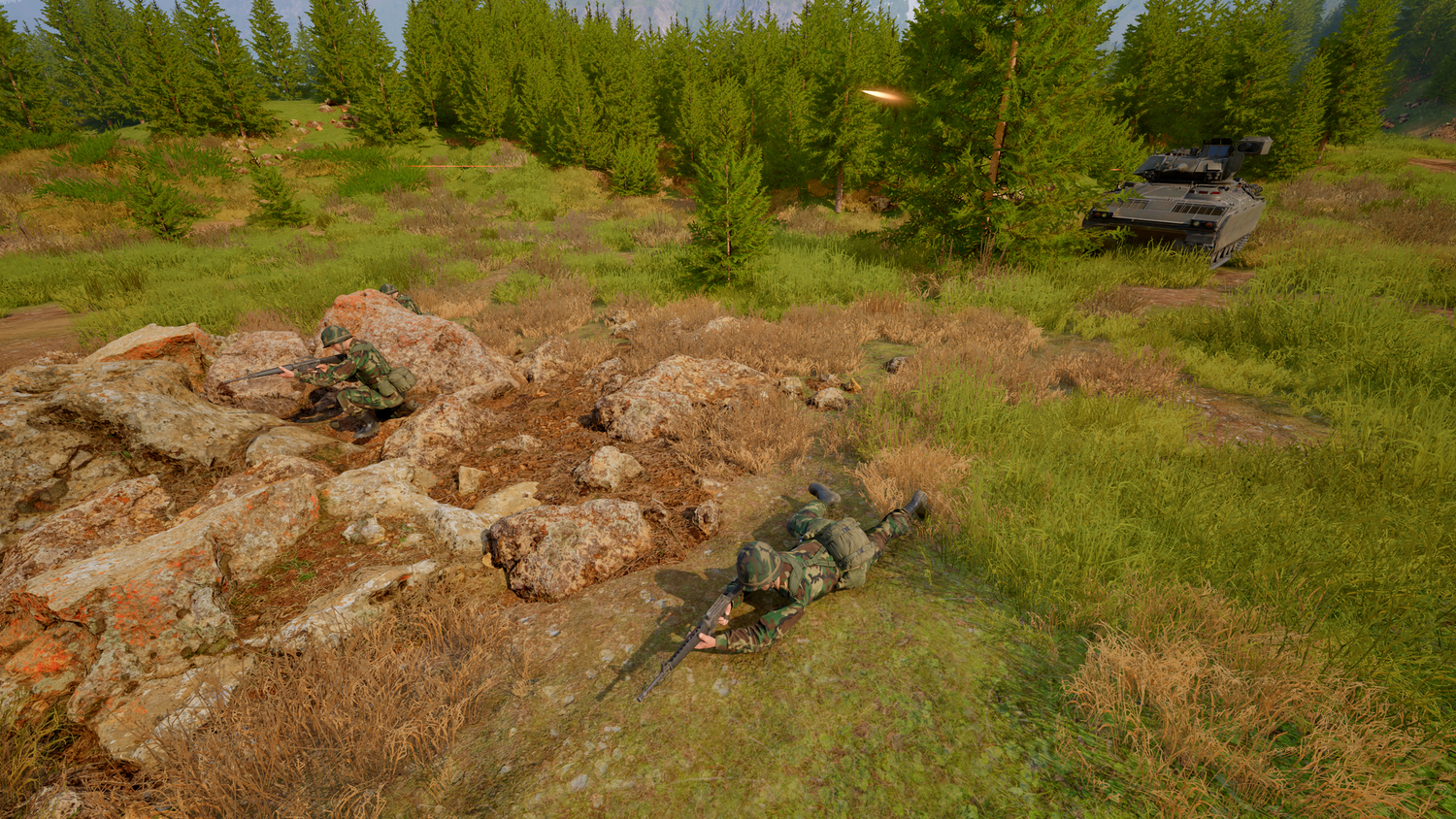
Suppress. Then move.
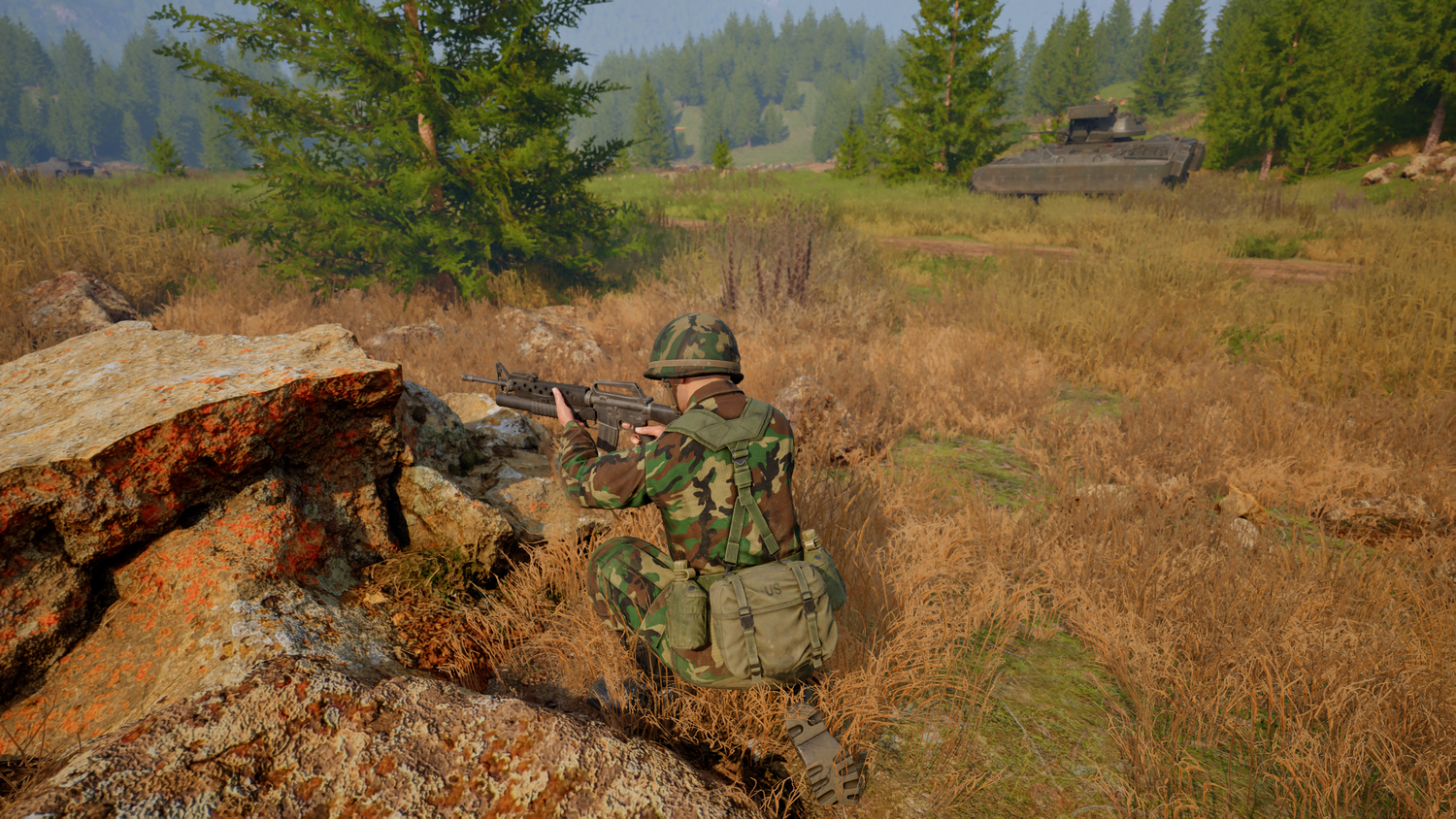
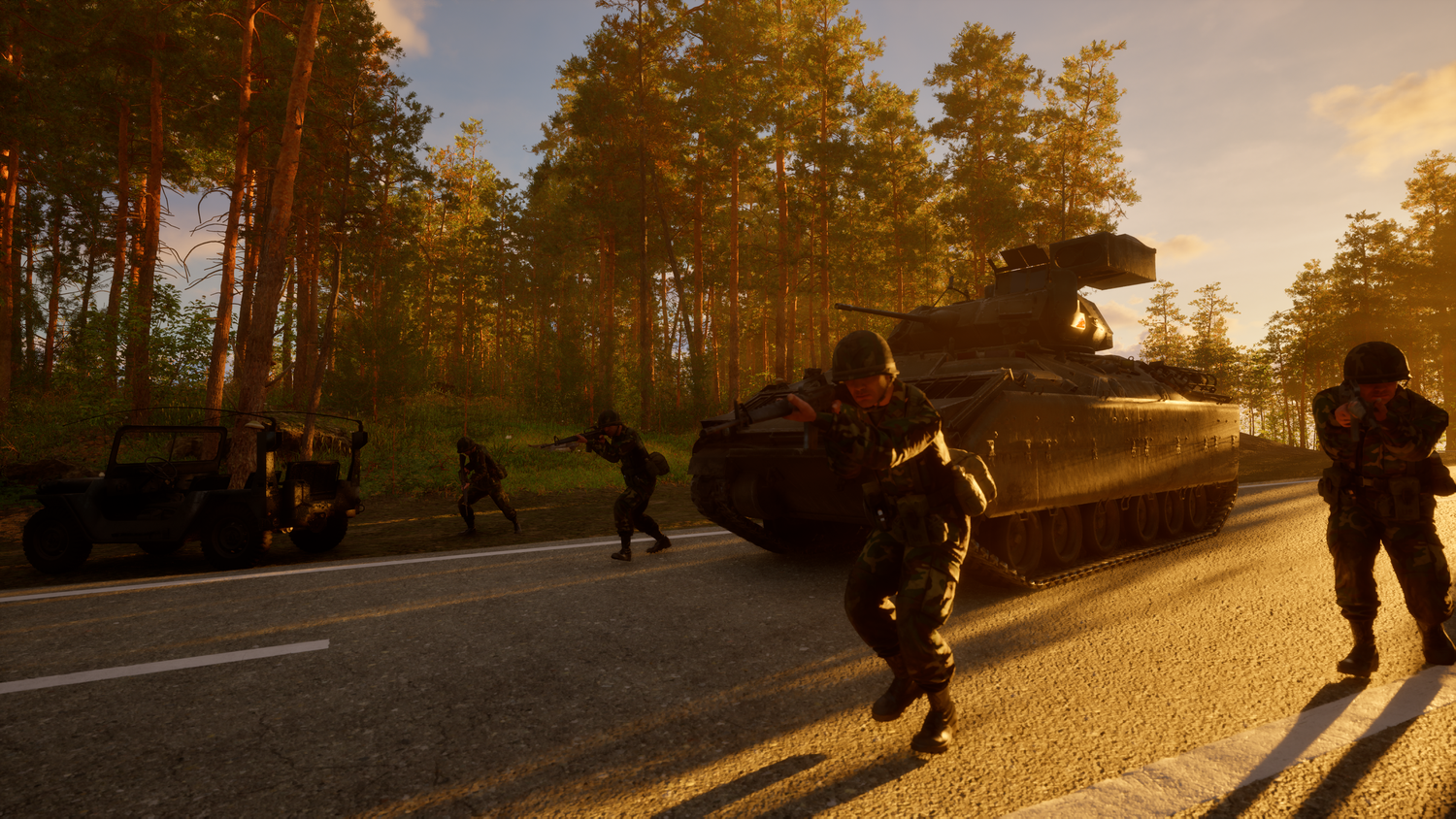
Firefights last minutes and are won with fire and movement, not aim. Most rounds miss, and their job is to pin. Dirt and bark fly off the treeline where the bursts land; a squad that was kneeling goes prone, then flat and shouting. One rifle round can put a man down, so there are no bullet sponges and every hit counts. When your fire has an enemy element pinned, your squad leader calls it (“They’re down — go!”) and for a few seconds the assault is decisive. Miss the window and your men walk into the fire.
Ballistics, penetration by aspect, engagement ranges and sound are built from period sources. Soviet tracers burn green and yours burn red, so you can read the shape of a firefight by colour. The Bradley’s 25mm walks tracer down a column; a TOW flies seconds on its wire and has to be held on target. The enemy bounds, flanks and breaks contact the way it was trained to, and its commander replans when yours does.
0512 1st Sqd base of fire from spur. Enemy dismounts pinned in ditch approx. 40 sec. 0513 2nd Sqd assault from reverse slope. Position cleared. 0514 1× WIA (leg). Stabilised under fire by Doc. 25mm expended: 86 HE · TOW expended: 1
Command the platoon, not the pieces.
You play the lieutenant, not a floating cursor. The platoon fights as four elements, each a Bradley and the half-squad riding in it, one hotkey each. Eight verbs cover what you can order: Move, Bound, Suppress, Assault, Hold, Withdraw, Mount, Dismount. One-click battle drills package the doctrine: React to Contact, Break Contact, Overwatch-Bound, Herringbone. Understanding what an order means is easy. Deciding which order is right is hard.
Pause and the world drains of colour. Draw intent lines on the ground; read the line-of-sight fans from spotted positions, the exposure along each route, the noise radius of a moving track. These are estimates, never guarantees, and only as good as your scouts. Release, and the plan snaps into motion. Fire orders go out in half a second. Movement waits on the chain of command: the squad leader turns, gestures, shouts, and only then do the men go. Sometimes a man reads the ground differently and takes the culvert instead of the bound you ordered. He might be right.
2-1: Contact. Treeline, two o’clock, three hundred. 2-6: 2-1, suppress. 2-2, bound left on my mark. 2-2: …Wilco. Moving. 2-6: Mark.
Six hours until dawn.
When the shooting stops, the other half of the game begins. The platoon harbours up in the Laager, and you have six Command Hours before first light, each one spendable only once. Repair the thrown track or let the crew sleep. Train the new gunner on the Bushmaster or post a second sentry. Pair the man who is shaking with the one who isn’t. Bury the dead. Write the letter. Sign the after-action report.
Nothing you decide at night pays off at night. It lands in the morning: in who is steady, which engine starts, who can still cross open ground. At dawn the Morning Report tells you in plain words what changed overnight and why. The only music in the game plays here, from a tape through the Bradley’s speaker.
2100 Stand-to 2200 Wrench: track tension, Bravo-2 2300 Ski qualifies Bull on the M60 0000 Rest: 1st Squad 0200 Burial detail 0400 Stand-to 0500 Roll
Nobody is coming.
The whole campaign runs under radio silence. No resupply, no artillery, no air: nothing arrives from off the map. Every round of 25mm, every TOW and every litre of diesel is counted, and the counts only go down. High-explosive and armour-piercing are tracked separately. A real firefight burns through a few minutes of ammunition, so spend it early and you will feel it late.
So you take what the enemy has. Strip the wrecks. Ambush the fuel columns and drink their diesel. Hand out captured Kalashnikovs, and accept that men who don’t know them shoot worse until they learn. Whatever a man carries costs speed and noise: extra belts, a spare launcher, a document case taken from an abandoned office. Somewhere along the road the platoon finds a Soviet BMP-1S with a name painted on the bow: Вера. To an American eye it reads “Bepa.” She carries the wounded, the weight and the names.
Ma — We eat what we find and we drive on their gas now. Wrench says the Russian track runs on prayer. She runs. Don’t worry. Gravel counts us every night.
What they become is yours.
The cast is written (Gravel is always the Vietnam veteran, Ski always starts on the machine gun), but what each man becomes is up to you. Backgrounds say who a man was before the Army: the farm kid drives anything, the hunter stalks, the college dropout reads a map and argues with your plan. Schools are what the Army made of him: the Ranger tab, the Expert Infantryman Badge, the one Bradley Master Gunner the platoon cannot afford to lose.
Skills improve through repetition, and only real use counts: a hit at range under pressure, not spraying from behind a wall. Teaching costs night hours and needs a teacher who is better than the student, so if your machine gunner dies, nobody trains the next one. The war also leaves its own marks. Perks are earned in action and cut both ways: “Steady under fire.” “Won’t leave a man.” “Freezes at casualties.” The card carries no numbers, only the words a lieutenant would write in a fitness report. Run a battle drill cleanly enough times and the squad makes it second nature. Two campaigns produce two different platoons.
SSG Kowalski, “Ski” Ranger · EIB Machine gun: Expert Steady under fire. Won’t leave a man. Hasn’t slept.
Raiders or ghosts.
Before the war there is the garrison. From April to August 1985 you meet your men, choose who gets the scarce school slots, run the ranges and a force-on-force exercise, and decide who gets the crash course when the new Bradleys arrive early. Then an exercise on the Helmstedt corridor becomes the war’s first night, and one wrong turn puts the platoon on the wrong side of the wire.
From there it is thirty days south through the Soviet rear: twelve missions with optional branches, ending at the bridge at Creuzburg. Everything you do is heard by someone. Gunfire, road movement by day, a burning tanker, a second night in the same laager: each one brings the hunters closer, a detachment with trackers, dogs and a direction-finding team sent to find you. You never see a number, only signs. A checkpoint that wasn’t there yesterday. Dogs at night. Webb hearing a new net come up. Raids stall the enemy’s advance and silence keeps you alive, but the war’s own clock means you cannot hide forever. What the platoon becomes on the road decides who reaches the river.
Dear Ma, Webb says they talk about us on their radios now. Gravel says that means we’re doing our job. I don’t know which one of them to believe.
Execution
b. Scheme of Maneuver — Two Armies, One War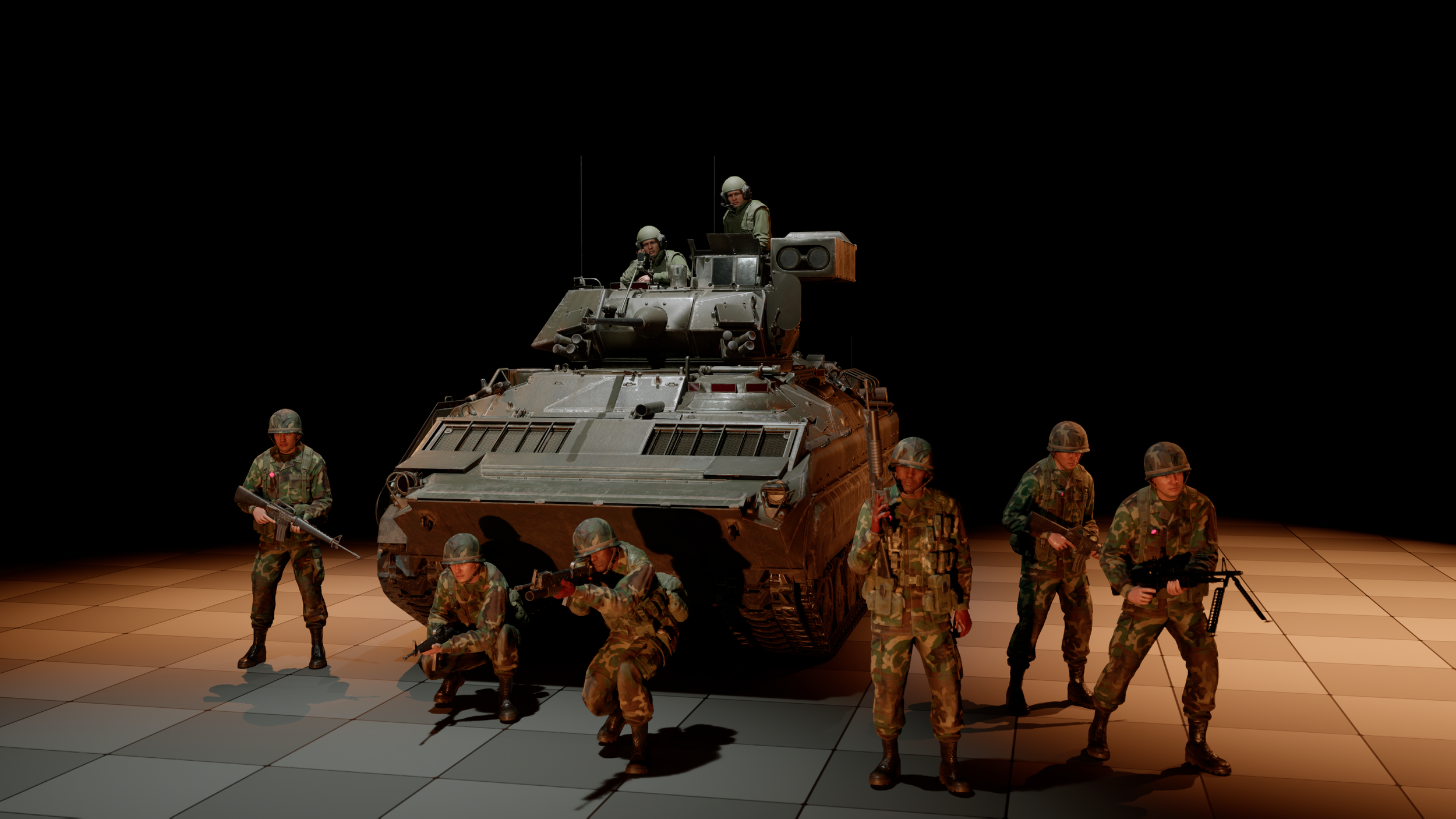
Able
Sentinel
NATO · U.S. Mechanized Platoon
An exercise on the Helmstedt corridor becomes the war’s first night. Stranded east of the wire with two Bradleys and sixteen men, you fight thirty days south through the Soviet rear — delaying an army, starving its fuel, bringing them home.
- PL
- Mac · the lieutenant · you
- PSG
- Gravel · keeps the count
- RTO
- Webb · hears their nets
- Medic
- Doc
- Mech
- Wrench · keeps her running
- Strength
- 16 / 29 · nine missing
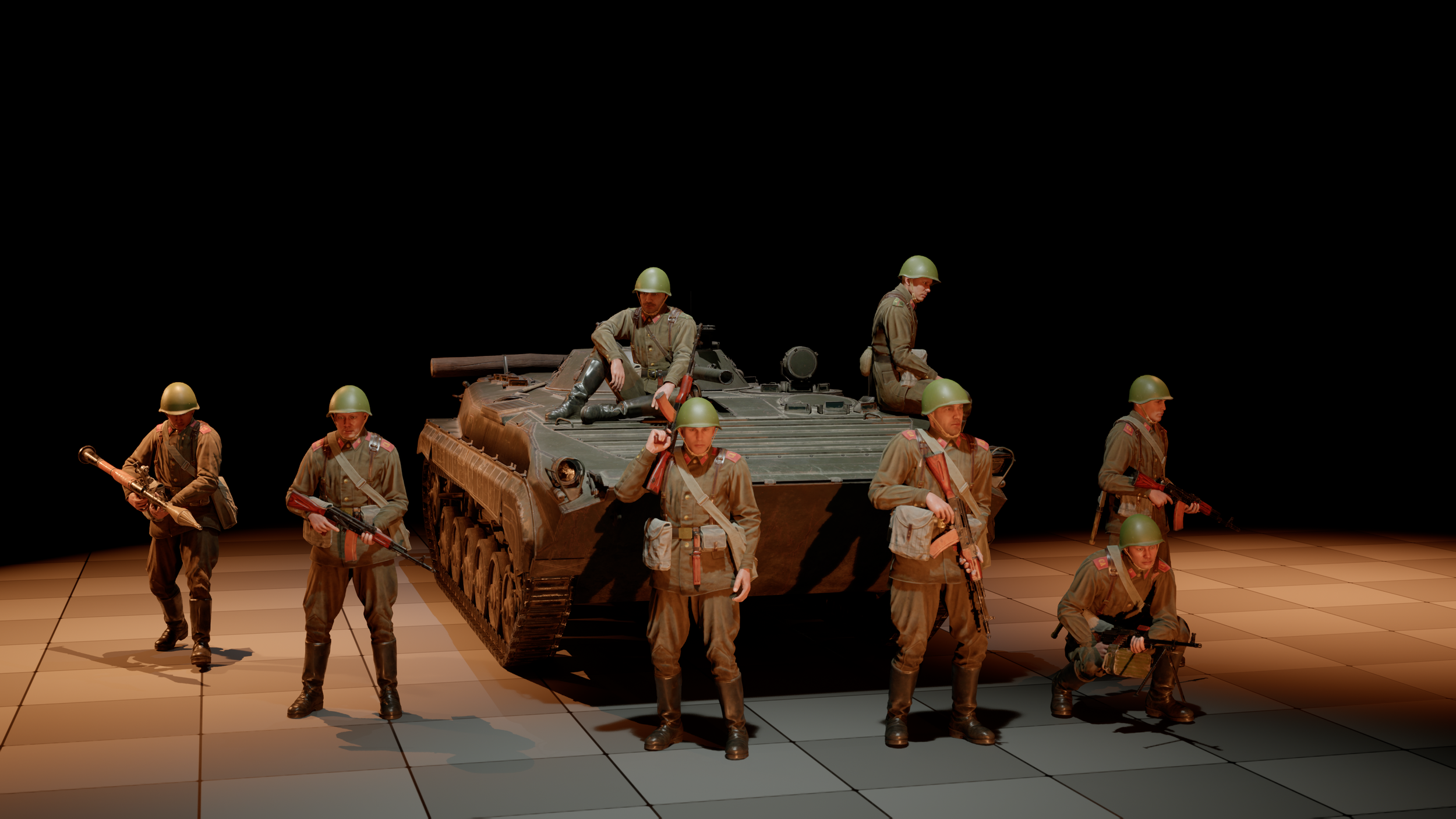
Operation Jupiter
Warsaw Pact · Soviet Motor-Rifle PlatoonExecute the plan a generation rehearsed. Ordered west and ordered not to stop, you carry a timetable that treats your platoon as a number — and discover what the timetable costs.
- Platoon
- Motor-rifle · 1985
- Vehicles
- 3× BMP-1P
- Doctrine
- Modular squads
- Status
- First planned expansion
Delay the advance. Starve its fuel. Bring them home.
Thirty days south to the bridge at Creuzburg. Three orders — they will not all survive contact, and you decide which one bends.
Imagery
Transmissions & captures — unretouched, in-engineReal time. Tactics.
Platoon-level contact, unedited: a U.S. squad and a Soviet squad meet in the same field, in real time, with nothing scripted. This is the prototype the whole combat model is built on.
The Plan
Phase lines — what ships, and what followsNATO Campaign
Able Sentinel — twelve missions, thirty days behind the lines, roughly 12–15 hours. Story-driven, single-player.
Warsaw Pact Campaign
Operation Jupiter — the same war from the attacker’s chair, the offensive you spent the first campaign surviving.
Multiplayer
Team-based command, players against players, on the ground you learned in the campaigns.
Get on the net.
Two ways to stay in contact with the line. The Dispatch List brings Field Reports to your inbox. The Discord is the open net — where the team and the platoon talk.
Questions
Frequently asked — answered plainlyQ.01What is Shattered Doctrine?
A plot-driven real-time tactics game set in August 1985. One wrong turn strands a U.S. mechanized platoon behind Soviet lines; you are its lieutenant, commanding sixteen named survivors through a thirty-day campaign where the dead stay dead.
Q.02When does it release?
It is in development, targeting late 2028. Dispatch List members hear first about demos, playtests and the Steam page.
Q.03How long is the campaign?
Able Sentinel runs twelve missions across thirty in-game days — roughly 12–15 hours — with optional branch missions that change what you carry into the finale.
Q.04What platforms?
PC, via Steam, built in Unreal Engine 5. Planned text languages: English, German, Russian, French, Polish and Spanish; English voice-over.
Q.05Is it an RTS?
Real-time tactics, not base-building. No economy, no production — your platoon is already in the field. Missions play in real time; between them, the six command hours of the Night Phase decide who goes into the next fight.
Q.06Can I play the Soviet side?
Yes — Operation Jupiter, the Soviet mirror campaign, is the first planned expansion. The NATO campaign, Able Sentinel, ships at 1.0.
Q.07Will there be multiplayer?
Version 1.0 is single-player. Multiplayer sits on the roadmap after both campaigns.
Q.08Who is making it?
Axiom Tactics LLC, an independent founder-led studio. In-engine footage and system tests go out on the YouTube channel; Field Reports go to the Dispatch List.